


LS2 Section Proteomics

Formerly known as the Swiss Proteomics Society (SPS), the LS2 Proteomics Section became part of Life Sciences Switzerland (LS2) in 2016. Today, it brings together a vibrant community of more than 180 members dedicated to advancing proteomics research, fostering scientific collaboration, and promoting education and training in Switzerland and beyond. By connecting researchers and professionals across disciplines and institutions, the section helps drive innovation in proteomics and strengthen the Swiss and international proteomics communities.
Section Board
Alexander Schmidt
Proteomics Core Facility, University of Basel

Paolo Nanni
Functional Genomics Center Zürich, ETHZ

Michal Bassani-Sternberg
CHUV Lausanne

Loic Dayon
Nestlé Research

Maria Pavlou
Proteomics Core Facility, EPF Lausanne

Bernd Wollscheid
ETH Zürich

Roland Bruderer
Biognosys AG

Alexander Leitner
ETH Zürich

Franziska Voellmy
Roche Pharmaceutical Research and Early Development (pRED)
How to join the LS2 Proteomics Section?
Existing LS2 Members: Log in at www.ls2.ch using your member name and password. Click on your name at the top right of the page. Go to "Account Overview" and add the new section using the checkbox "Proteomics". Alternatively, you can write to the LS2 office (info@ls2.ch) and request the change.
New Members: Apply for the LS2 membership here and select "Proteomics" in the online application form.
News and Events:
Our Symposium at the Annual Meeting 2027!
From Proteome to Mechanism: In Vivo Insights into Cellular Biology
How can proteomics and metabolomics reveal what is happening inside cells and tissues in their physiological context? This symposium will explore how advanced omics approaches can move from mapping cellular states to uncovering biological mechanisms, from the tumour microenvironment to complex organoid models. Alex Jaeger will present a new approach to lineage-restricted immunopeptidomics, revealing how antigen presentation varies between cell types in the tumour microenvironment and changes throughout tumour evolution. Celia Berkers will discuss how metabolomics and fluxomics, combined with complex model systems, can uncover metabolic dependencies in cancer, identify potential therapeutic targets, and reveal how metabolic communication within the tumour microenvironment contributes to drug resistance.
Join us on 10 February 2027, starting from 14:30.
THANK YOU - Swiss Proteomics Meeting 2026
The Swiss Proteomics Meeting 2026 took place on 23–24 April at the Holiday Inn Bern Westside in Bern, bringing together researchers to share scientific advances, exchange ideas, and foster collaborations in proteomics. The meeting featured two inspiring keynote speakers: Prof. Anne-Ruxandra Carvunis (ETH Zurich), who explored the dark proteome and its emerging role in systems biology, and Prof. Jesper Olsen (University of Copenhagen), who presented advances in single-cell proteomics, focusing on protein turnover and abundance. The programme provided an excellent opportunity for scientific exchange and for early-career researchers to present their work.
Many thanks to all speakers, participants, and sponsors for making the meeting a success!
Meeting pictures can be found HERE.
We hope to see you all next time!

Prize Winners - Swiss Proteomics Meeting 2026
Congratulations!
Best Talk - Jonas Grossmann (University of Zurich) - 450 CHF sponsored by MDPI Proteomes
Best Flash Talk - Curdin Andri Franziscus (University of Basel) - 450 CHF sponsored by Affinisep
Best Flash Talk - Chiara Palermo (University of Bern) - 450 CHF sponsored by Roche

LS2 Travel Grants to HUPO/EuPA - Swiss Proteomics Meeting 2026
The winners are:
Melanie Brunner (University of Fribourg) - 1000 CHF
Xindong Sun (University of Zurich) - 1000 CHF
Lopamudra Chatterjee (University of Zurich) - 500 CHF
Philipp Gessner (University of Zurich) - 500 CHF

Swiss Proteomics Meeting 2025
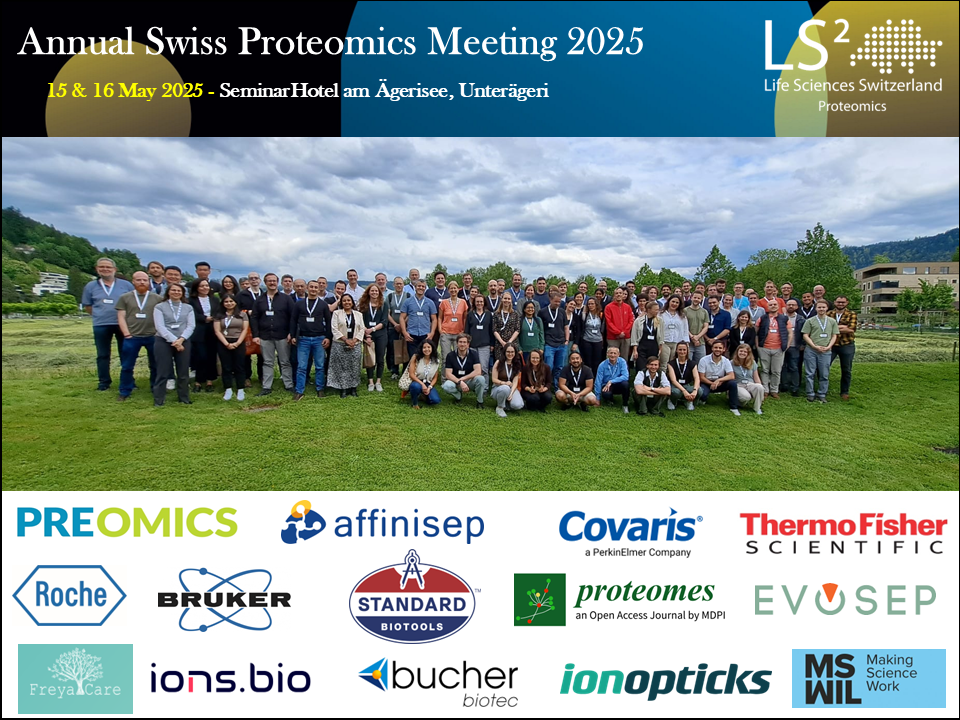
The Swiss Proteomics Meeting 2025 took place on 15–16 May at SeminarHotel am Ägerisee in Unterägeri, bringing together researchers to share scientific advances and foster collaborations in proteomics. Keynote speakers Prof. Ruth Huttenhain (Stanford University) and Dr. Marcus Bantscheff (Roche) presented exciting developments in proteomics, from studying protein interactions and cellular signalling to understanding drug targets and mechanisms. The meeting also featured a workshop on artificial intelligence in proteomics, highlighting emerging tools and approaches in the field.
A big thank you to all our speakers, participants, and sponsors for making this meeting a success!
Take a look at the meeting photos HERE.
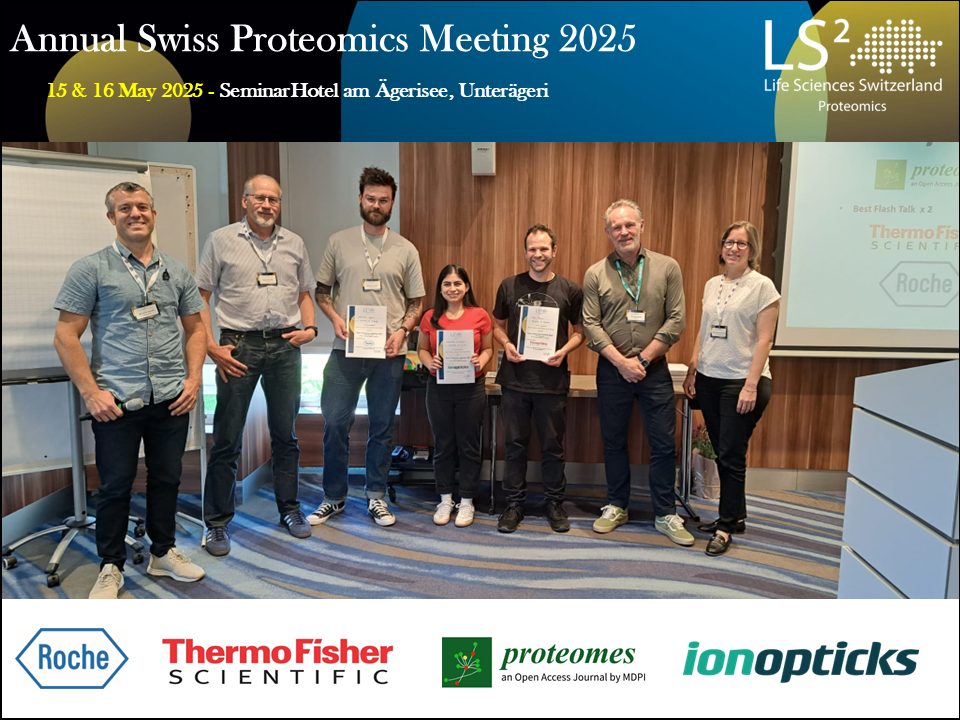
Prize Winners at Swiss Proteomics Meeting 2025
Congratulations!
Best Talk - Lopamudra Chatterjee (University of Zurich) - 450 CHF sponsored by IonOpticks
Best Talk - Marc van Oostrum (University of Basel) - 450 CHF sponsored by MDPI Proteomes
Best Flash Talk - Ilja Shapiro (University of Lausanne) - 450 CHF sponsored by Thermo Fisher Scientific
Best Flash Talk - Alexandre Leytens (University of Fribourg) - 450 CHF sponsored by Roche
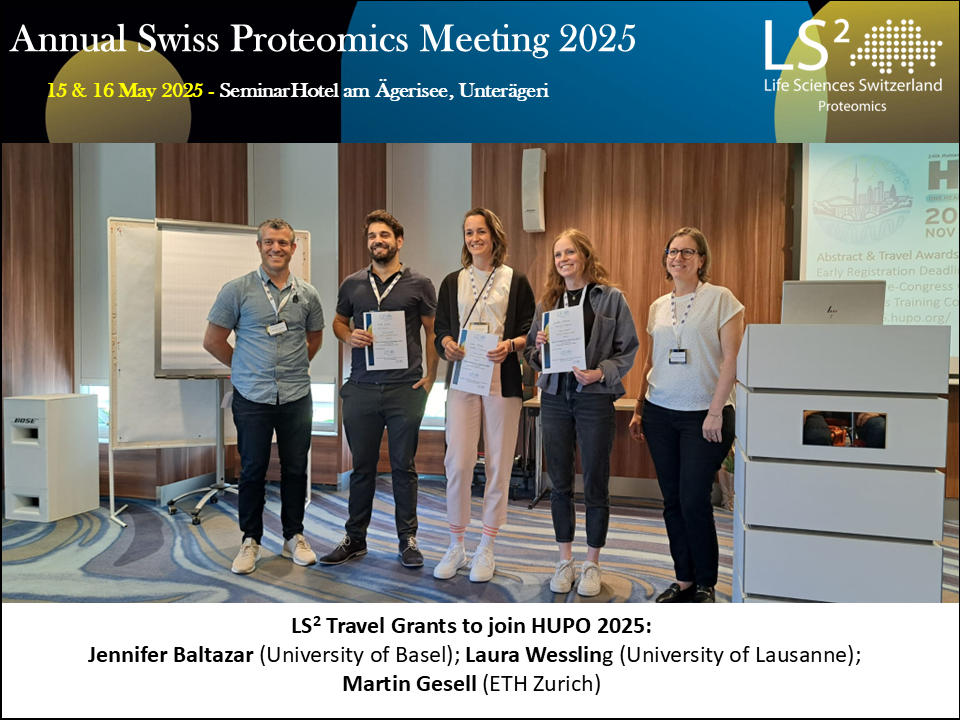
LS2 Travel Grants to HUPO 2025
Congratulations!
Jennifer Baltazar (University of Basel) - 1000 CHF
Laura Wessling (University of Lausanne) - 1000 CHF
Martin Gesell (ETH Zurich) - 1000 CHF
Swiss Proteomics Meeting 2024
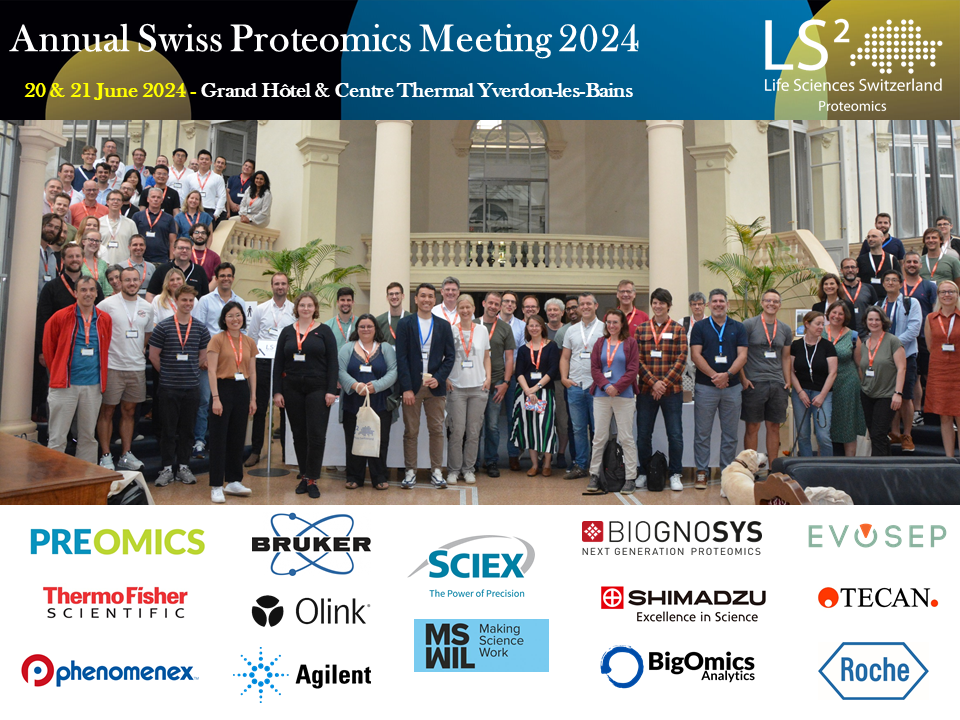
The Swiss Proteomics Meeting 2024 took place on 20–21 June at the Grand Hôtel & Centre Thermal in Yverdon-les-Bains, bringing together researchers from Switzerland and neighbouring countries to share scientific advances, exchange ideas, and foster collaborations in proteomics. The meeting featured inspiring keynote lectures by Dr. Kirti Sharma (Kymera Therapeutics, USA) and Dr. Fabian Coscia (Max Delbrück Center for Molecular Medicine, Germany), who presented exciting developments in mass spectrometry-based proteomics, targeted protein degradation, and spatial tissue proteomics. The programme also included a career development panel discussion and a workshop exploring how proteomics can drive drug development. Many thanks to all speakers, participants, and sponsors for contributing to the success of the meeting!
Meeting pictures can be found HERE.
Swiss Proteomics Meeting 2023
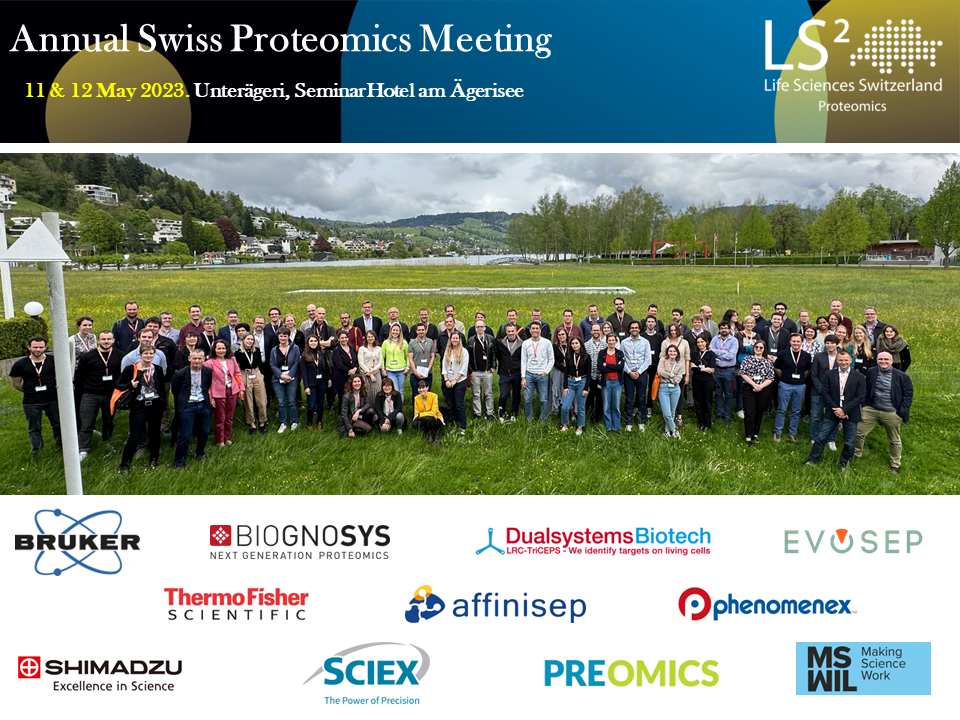
The Swiss Proteomics Meeting 2023 took place on 11–12 May in Unterägeri, bringing together researchers to exchange ideas and explore advances in proteomics. The meeting featured two keynote speakers: Prof. Chris Tape (UCL Cancer Institute, UK), who presented research on single-cell signalling in tumour microenvironments, and Prof. Tami Geiger (Weizmann Institute of Science, Israel), who explored the role of the immune system in cancer proteome heterogeneity. The event provided an excellent opportunity for scientific exchange and collaboration within the proteomics community.
Congratulations to Justine Epiney (EPFL), who received the Best Oral Presentation Award, and Tatjana Sajic (University Hospital Lausanne), who received the Best Flash Talk Award. Many thanks to all speakers, participants, and sponsors for contributing to the success of the meeting!
LS2 Proteomics members are affiliated with EuPA. The European Proteomics Association (EuPA) is the federation of European national proteomics societies. The main objectives are to strengthen and promote fundamental research and applications, as well as education and training in all areas of proteomics throughout Europe.

Explore the HUPO Upcoming Events Calendar to discover international conferences, workshops, and scientific meetings in proteomics and related fields. It is a valuable resource for staying up to date with upcoming events, sharing knowledge, and connecting with the global proteomics community.
You can contribute to the official newsletter of the European Proteomics Association. Send in information about “who is who in proteomics” (research groups, scientists); new books, papers and databases; announcements of meetings, courses, thesis, and job offers. Also brief notes on key methodological or biological issues, complementary approaches, recent relevant literature are very appreciated.
The Proteomic Forum – EuPA 2026 invites researchers, clinicians, industry professionals, and early‑career scientists to Würzburg, Germany, from November 29 to December 3, 2026. Hosted by the European Proteomics Association (EuPA) and the German Society for Proteomics, this flagship conference brings together thought leaders and innovators to explore the latest breakthroughs in proteomics research and technology.
This annual congress is designed to showcase cutting‑edge science through a rich program of eight plenary lectures and seventeen specialized symposia covering diverse themes such as clinical proteomics, AI in proteomics, systems biology, drug discovery, immunoproteomics, and single‑cell approaches.
Submit your abstract and join in!
Early bird registration deadline: July 15, 2026. Registration possible until September 15, 2026.

Our Symposium at LS2 Annual Meeting 2026 will be chaired by Paolo Nanni (FGCZ, University/ETH Zurich) and Loïc Dayon (Nestlé Research, Lausanne): “Proteomics in the Era of Multi-Omics”
Speakers:
Rudolf Aebersold (ETH Zurich): "On the dependency of cellular states on the adaptable modular proteome"
Jana Seifert (University of Hohenheim, DE): "Using metaproteomics for livestock microbiome research"
Register by 11.01.2026.
The Meeting will take place on 11 & 12 February 2026 at Campus Irchel of the University of Zurich.
23-24 May 2019, Eurotel Montreux
A great opportunity for PhD students, post-docs and group leaders to learn from & connect with researchers using advanced mass spectrometric strategies in order to get mechanistic insights into dynamic biological processes. More info HERE.
All meeting pictures can be found here (photo credits: Matthias Gstaiger/ETHZ and Elena Cardenal(EC)/LS2)


20.-21. April 2017, Thun (Hotel Freienhof)
All meeting pictures can be found here (photo credit: Matthias Gstaiger, ETHZ)
See you again in 2018!
The SPS/LS2 organization committee
